




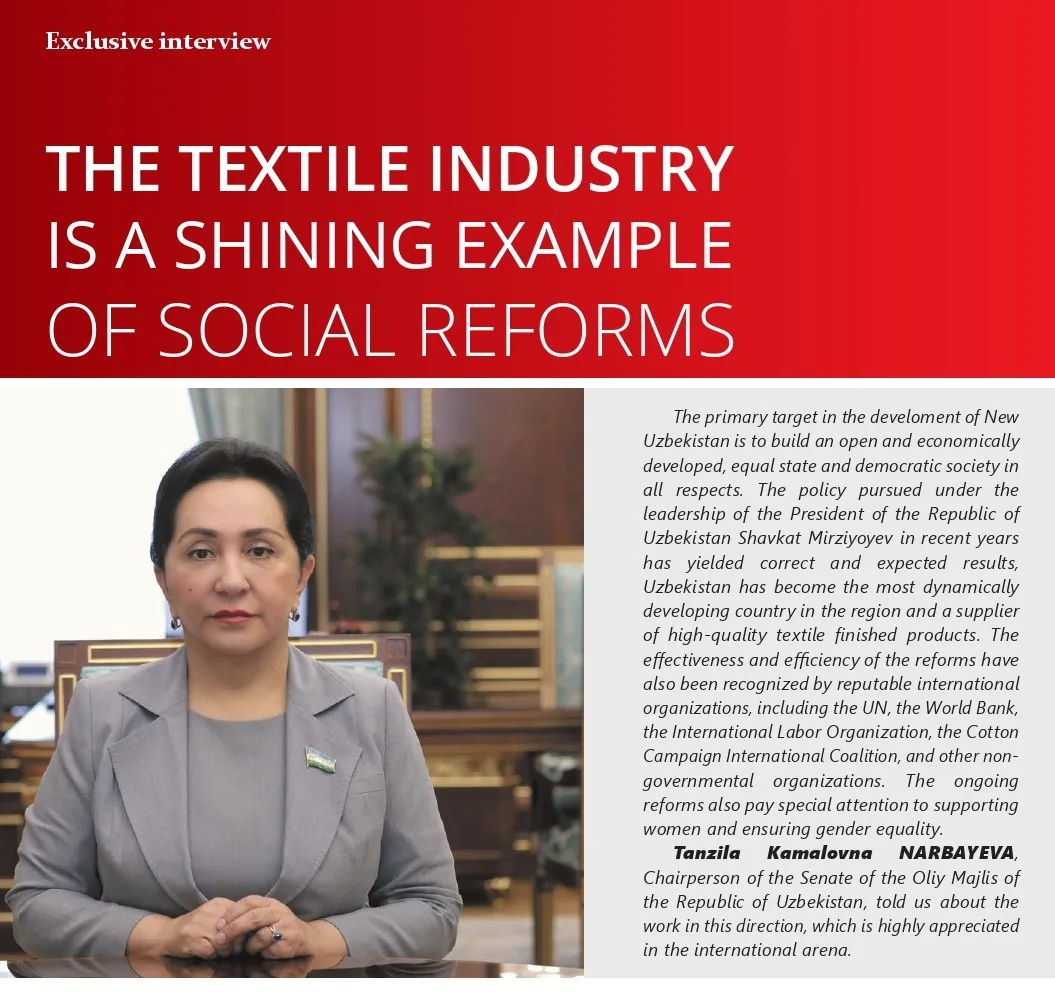
The primary target in the develoment of New Uzbekistan is to build an open and economically developed, equal state and democratic society in all respects. The policy pursued under the leadership of the President of the Republic of Uzbekistan Shavkat Mirziyoyev in recent years has yielded correct and expected results, Uzbekistan has become the most dynamically developing country in the region and a supplier of high-quality textile finished products. The effectiveness and efficiency of the reforms have also been recognized by reputable international organizations, including the UN, the World Bank, the International Labor Organization, the Cotton Campaign International Coalition, and other nongovernmental organizations. The ongoing reforms also pay special attention to supporting women and ensuring gender equality.
Tanzila Kamalovna NARBAYEVA, Chairperson of the Senate of the Oliy Majlis of the Republic of Uzbekistan, told us about the work in this direction, which is highly appreciated
in the international arena.
– Tanzila Kamalovna, today we recognize that the textile industry has become the driver of the economy of Uzbekistan and generates employment of women more than all industries. In this regard, our readers are interested in what issues of gender equality and social stability that affect the interests of textile workers are currently being dealt with by the Senate?
– Actually, at the present stage, consistent and democratic reforms are being carried out in New Uzbekistan in all spheres of life, effective measures are being taken to ensure human rights, increase the role of parliament, civil society institutions and the media, the political activity of the population, and also create all the necessary conditions for so that everyone lives in peace and prosperity.
Today, the multinational people of Uzbekistan live with the great goal of achieving a standard of living corresponding to developed countries, building a just, free and stable society. For this purpose, as well as determining the strategic prospects for the development of the state and society, under the leadership of the President of Uzbekistan Sh. Mirziyoyev, a program document has been developed and is being implemented – the Strategy for the Development of New Uzbekistan for 2022-2026. The central place in the Strategy is occupied by the tasks of building a people’s and humane state that ensures the legitimate interests and wellbeing of every citizen on the basis of the ideas «In the name of human honor and dignity» and «The State for people».
According to the data from the UN, women today generate about 40% of global GDP. And it is estimated that if women were represented on an equal footing with men in all sectors of the economy, global GDP would increase by $28 trillion, or 26%, by 2025. That is why gender equality, one of the most important human rights, plays a key role in ensuring peace and harmony in society and the fullest realization of human potential through sustainable development.
Some time ago, gender equality issues were more declarative in nature. However, in recent years, thanks to the reforms carried out under the leadership of President Shavkat Mirziyoyev, we have achieved significant results. Thus, gender policy has become a system-forming factor in the development of society and the state. Concepts such as «gender and development», «gender expertise», «gender balance», «the role of women in social and political life» in fact are reflected in all program documents of the state and in the development of any normative legal act.
The Senate of the Oliy Majlis is directly involved in the development of the textile industry of the republic. The Republican Commission on the Promotion of the Role of Women in Society, Gender Equality and the Family, chaired by the President of the Senate, and the National Commission on Combating Trafficking in Persons and Forced Labor conduct comprehensive research, develop and implement effective measures to ensure gender equality, support women, their employment in various sectors of the economy, including textiles, and create decent working conditions for them.
Here, the activities of the commissions are aimed not at improving statistics in this sphere, but at constantly taking care of our women, ensuring their rights and solving problems that concern them.
When systemic child labor was completely eradicated in 2016, the European Parliament ratified the inclusion of a textile protocol in the EU-Uzbekistan Partnership and Cooperation Agreement, which provides for the abolition of quantitative restrictions and a reduction in customs duties when importing three thousand items of Uzbek textile products into the European Union countries. And in 2017, the Senate of the Oliy Majlis ratified the inclusion of Uzbekistan’s textile products in the Bilateral Trade Agreement with the EU.
One of the important tools of parliamentary control is the parliamentary inquiry, which will be effectively applied in the activities of the Senate. In 2022, in order to study the state of protection of women’s labor rights at enterprises of the light and leather industry, a corresponding parliamentary request was sent to the Cabinet of Ministers. The study of the data showed that all the necessary conditions have been created at the enterprises of the light and leather industry to ensure the qualitative provision of women’s labor rights and decent pay for their work.
In all measures taken, the main focus is on ensuring gender equality. Not only is there a gender balance in every enterprise, but also legal conditions to support women in order to prevent infringement of their rights.
– As a result of efforts to eradicate forced and child labor in Uzbekistan, the international coalition Cotton Campaign lifted the cotton boycott imposed on Uzbekistan in March 2022. What is your opinion, what kind of opportunities will this event give for the future of our country and what indicators might be achieved socially?
– It is no secret that for more than 12 years our cotton was under the so-called boycott, which did not allow many world brands to enter the textile market of Uzbekistan. However, democratic transformations, reforming the national economy, in particular measures to liberalize foreign trade, tax and financial policies, supporting business and guaranteeing the inviolability of private property, organizing deep processing of agricultural products, as well as work to ensure the accelerated development of the regions have brought tangible results.
The abolition of the cotton restriction – boycott should be considered as a natural consequence of the large-scale reforms initiated by the President in the cotton and textile industry. Such measures as the reduction of the state’s presence in the agricultural sector, the abolition of the establishment by the state of a production plan, the transition to market relations in cotton production, the diversification of agriculture through the creation of a cluster system, the prevention of forced and systematic mobilization of labor in the cotton sector, including by ensuring control and independent monitoring.
Taking into account the effectiveness and efficiency of the reforms carried out in this industry, on March 10, 2022, the Cotton Campaign international coalition officially announced the cancellation of the cotton boycott against Uzbekistan.
Today, the whole world is welcome the Uzbek textiles. The cancelation of the boycott of Uzbek cotton serves to create millions of new jobs, especially in rural areas, as well as attract foreign investment in the textile industry and expand Uzbekistan’s export potential.
After the cancellation of the cotton boycott, large international companies such as Inditex Group, MANGO, KIABI and a number of other popular textile brands are increasingly actively entering or planning to enter the republic’s market.
– Thanks to recent reforms in the textile industry and the active cooperation of the National Commission with the ILO and BCI, the Better Work and Better Cotton programs have been officially launched in our republic, and a number of events have already been held. How important are these projects in the textile industry?
– Lifting the boycott of Uzbek cotton is a political part of solving the problem, as I have already noted, all difficult issues have been resolved. In 2022, with the coordination of the National Commission, we adopted and are actively implementing a roadmap for the implementation of international technical standards and production criteria based on the requirements of international brands in the textile industry. It defines measures such as the introduction of social, labor, environmental, recycling and circular economy standards, as well as transparency and traceability standards.
In May of this year, a project was launched to implement the joint program of the International Labor Organization and the International Finance Corporation Better Work, aimed at developing standards of decent work and entrepreneurship in the textile industry of Uzbekistan. A Joint Sustainability Action Plan 2023-2024 was also signed between Better Cotton and the National Commission on Combating Trafficking in Persons and Forced Labour.
In Uzbekistan, the BCI project is considered to be in demand and relevant for the further implementation of international standards in the activities of cotton and textile clusters, as well as for improving the practice of growing cotton. Moreover, starting from 2023, BCI is among the first to introduce a cotton tracking system in Uzbekistan along the entire supply chain. This will allow the Uzbek cotton products to be adapted in advance to the new EU requirements.
It also serves the entry of the world’s leading brands into the Uzbek market, attracting foreign investment, and creating new high-tech jobs for millions of people.
– As it has been already noted, the majority of workers in the textile and garment industry are women. What is being done to create decent working conditions for them and ensure the protection of their rights? To what extent are women’s rights reflected in the current legislation of Uzbekistan?
– Ensuring women’s rights and their comprehensive support is one of the priorities of state policy. This issue is reflected in the new version of the Basic Law of our state. The new Constitution of the Republic of Uzbekistan proclaims Uzbekistan a socially oriented state and enshrines a number of social rights and obligations of the state to citizens. It is noteworthy that more than half of the norms included in the Basic Law of the Republic are aimed at strengthening guarantees and mechanisms for the protection of human rights and freedoms, in particular women’s rights.
Furthermore, on April 30, 2023, the new edition of the Labor Code of the Republic of Uzbekistan came into force, designed to protect the interests of all employees, regardless of their gender, and create favorable working conditions.
Today Uzbekistan has a large workforce. 600 thousand young people begin their activities in the labor market every year, and in the next 10 years this figure will reach one million. Special attention is paid to increasing the role of women in socio-political and economic life. Women make up 77% of those employed in healthcare, 74% in education, 46% in economic and industrial sectors. About two thousand women hold senior positions in state and public organizations. In general, about 44% of Uzbekistan’s labor resources are women. Now there are more than 12 thousand textile industry enterprises in the republic, where more than 5 thousand are focused on the production of finished clothing products. On the other hand, given that the textile industry is labor–intensive, the industry employs more than 500 thousand people, and 80% of them are women.
It is gratifying that in this area special attention is paid to supporting women, creating decent working conditions and ensuring their legal rights.
Our research shows that currently in the industry, women mainly work in working positions (spinner, weaver, knitter, seamstress, etc.), but also occupy the positions of managers – heads of workshops, departments, craftsmen. And recently there has been a tendency to increase the number of women in the director’s corps. It should be noted that already about 40% of the management corps of enterprises are occupied by female specialists.
Moreover, I would like to note that today such genderoriented laws as «On Guarantees of Equal Rights and Opportunities for Women and Men», «On the Protection of Women from Harassment and Violence», «On the Protection of Reproductive Health of Citizens» and many others have been adopted and are effectively operating in the country. In 2021, the Strategy for Achieving Gender Equality in Uzbekistan until 2030 was approved. Within the framework of this document, the National Program for Increasing the Activity of Women in All Spheres of the Economic, Political and Social Life of the Country for 2022- 2026 has been adopted and is being implemented.
The focus of all the adopted documents is on preventing cases of oppression of women, preventing their discrimination in society, working with prejudices and negative attitudes towards women, improving the situation with women’s employment, remuneration and protection of their labor rights.
Consistent work is being done to increase women’s access to higher education. If 6 years ago 110 thousand girls studied at universities, now there are already about 500 thousand of them. Five years ago, the enrolment rate of girls in the undergraduate system was at the level of 38%, and today it is already 49%, the coverage of the master’s degree has increased from 37 to 50 percent. Particular attention is paid to supporting women’s entrepreneurship, because it is an important driver of economic growth and sustainable development. Women’s Entrepreneurship Centers have been established in all regions of Uzbekistan.
These measures are aimed at increasing the activity of women in the socio-economic life of the country and show their effectiveness. I hope that these measures will strengthen the potential of women in the textile industry contributes to the development of the industry.
Foremost, we proceed from the fact that the success of one woman is the success of the whole society. In this regard, I am sure that our women and girls will make a feasible contribution to the further development of the textile industry of the republic and access to new world markets.
– Dear Tanzila Kamalovna, let me thank you for the interesting interview and wishing you success in your future endeavors aimed at the further development of our country.
Reproduction, copying, replication, distribution and other use of information from the uzts.uz website is possible only with a link to the association website